Dig Diary 2006
Our summer training dig for 2006 has now come to an end. See below for a day-by-day account of the progress of the 2006 training excavation. For further information on future excavation activity visit the Training Excavation page.
Monday the 10th of July 2006
Weather: Warm and cloudy
Welcome to the Lindum Heritage Dig Diary for 2006; the Diary will chronicle the progress of our excavation at Sudbrooke in Lincolnshire over the next four weeks. The site is located in an arable field, this year planted with beans. Previous evidence and interventions, including last season's work, indicate that it was once the site of a Roman villa. Having spent most of last week setting up the site (you know the usual ... surveying in trenches, JCB'ing off top-soil, building sheds etc.) at last we got the chance to do some recording and digging. With a whole new team of people on site most the morning was taken up with induction and introductions - to the site, to the recording system, and of course to each other. After lunch however we began in earnest by cleaning the full extents of this season's 'Area A'. (Above: Iris and Lucy start the digging in Area A)
For those of you who were lucky enough to work on the site last year this will seem strangely familiar - once again we have areas A and B, but don't be fooled they are not in exactly the same place, instead they overlap slightly with last year's trenches but are both positioned somewhat to the south-west of last years areas. In area A this will allow us to investigate the full(?) extents of the mortar floor surface found at the very end of the 2005 season - and I'm pleased to say that we have relocated that part of the 2005 trench; it was right where we left it! (Left: Alex clears the backfill over part of last year's excavation trench, while Rob and Lee - below - get to grips with the sieve).
On the staffing side we have some 'continuing' staff and a couple of newcomers. Zoe is still in charge of site management and has an overview of the the finds system, assisted once again by Iris who has returned from Holland for a second season. Helping Iris out for the first half of the excavation is Lucy an archaeology student from the Institute (UCL) who, more significantly, is a local who went to school in nearby Nettleham. On the digging side of things I - Craig Spence - remain in overall control but I now have the able assistance of Alex, an experienced professional archaeologist acting as Archaeological Supervisor. Anyway that's enough for now, check back tomorrow for more news of our progress.
Tuesday the 11th of July 2006
Weather: Clear skies and sun
Today started with some initial excavation of area A in order to record and then begin removal of the lower levels of the topsoil. This very mixed deposit directly overlay a variety of building material rich deposits of Roman date. We also spent some time cleaning up area B making it ready for excavation later this week, or next. Before lunch we were all treated to one of Lynne McEwan's great archaeological photography workshops - after which it's a job to get people to put down their cameras and pick up their trowels! The afternoon however saw a great effort to begin proper excavation in Area A. At last we began to expose the full surviving extents of the mortar floor surface found last year (see above). And as we did so we had a mild surprise. The remnants of two tiles mortared to the floor seem to be suggestive of a hypocaust (under floor heating) structure ... only further excavation will tell for sure.
Wednesday the 12th of July 2006
Weather: Sunny with a stiff breeze
Well now the weather is beginning to hot up and the archaeology is pretty good too. It's full steam ahead with recording and excavation in area A. Here we are now convinced we have the remnants of a hypocaust sub-floor and what is likely to be either associated wall foundations or robber trenches. The surface has suffered some plough-damage, though possibly not recently. The area as a whole has a number of different deposits which range from loose rubble and mortar to very stiff brown-grey clay. Over the next couple of days we should reach similar levels to those in last year's trench at which point we can start to marry-up the various deposits across both seasons.
Everyone seems happy, especially when digging - slightly less so when recording but then that's always a little tricky the first time around. Bill Bee, our local prehistory expert visited site this afternoon and gave an impromptu seminar on prehistoric flint artefact recognition - with tea and biscuits!
Thursday the 13th of July 2006
Weather: Slightly cloudy at first then sunny
Today started with a little confusion as the adjacent village hall where our morning Roman pottery workshop was planned to take place was overrun with toddlers ... the hall had been double booked! But within a few minutes a solution was formulated and the workshop rescheduled for after lunch - well done Zoe. So it was out to site where most people returned to area A and began to plan and record the next set of contexts. These seemed to consist of various clay and silt deposits apparently overlying the destruction horizon associated with the masonry building.
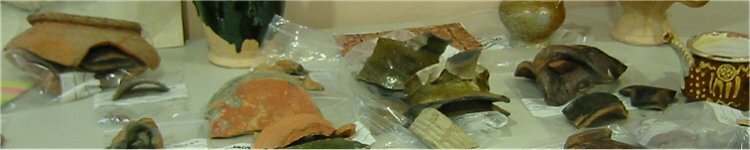
The afternoon then began, as promised, with one of Barbara Precious's marvelous Roman pottery workshops (see above). Barbara, and her colleague Maggi Darling, have a fantastic reference collection of Romano-British pottery which they bring along to their workshops. Everyone later returned to site with a new found knowledge and appreciation of the various sherds of Samian, grey ware, Nene Valley ware and amphora that we have been turning up. The day ended with the traditional Thursday evening post-work pint at the nearby 'Bottle & Glass'.
Friday the 14th of July 2006
Weather: Sun and then more sun
Last day of week one and it's flown by! With only a few bits and pieces of recording and excavation to do in area A, before a big clean up for photography next week we refocused our efforts to area B. And were almost immediately rewarded when the membrane laid down to protect the south-west corner of last season's excavation re-appeared. Once again just where we knew it would be, not a bad feat in a big field of four foot high beans. So while part of the team set about removing last year's backfill, the rest focused on removing the lower topsoil deposit above the large dump of compact building debris previously identified in the area.
It's been a great first week, with both of last season's trenches relocated and considerable progress already made in area A. The mortar floor is almost certainly the base of a hypocaust system, though with extensive plough-damage its full extents are yet to be defined. We've had lots of interesting 'finds' this week too, but pride of place goes to Iris's unstratified surface find of a large blue-glass faience, or melon, bead; though broken in half it is otherwise in very good condition, (photo to follow).
Monday the 17th of July 2006
Weather: Blazing sun and 32 degrees C
The start of week two and some new faces around the site. The week began with the usual introductions and inductions, and now that we've got something to see a quick site tour. After which we ventured out into the sun and set about excavating in Area B. Slower progress in area A where judicious cleaning of the hypocaust floor (mainly removing damage and fill within plough scores) has now revealed a couple of limestone blocks forming the western wall of the heated room.
The afternoon was enlivened by the visit of about 40 year 5 children from the nearby primary school - Ellison Boulter's. They had a great time touring the site, digging for finds in the digging pit, sieving spoil from area B and doing a bit of pot washing. They were well supervised throughout by Esther, Jacquie and Lucy who will be back at the end of the week when more school visits will be taking place. Overall a good start to the week but with the weather hotting up we might be forced to slow the digging down somewhat ... only time will tell?
Tuesday the 18th of July 2006
Weather: Very sunny and very hot
This morning featured another of Lynne McEwan's great photography workshops followed by slow but steady progress in Area B. The heat is certainly making the work on site difficult and as a consequence there's no end of volunteers for sieving - as it's in the shade. In fact with excavation progressing so well in area B - and not much happening in A - we went for double sieving (see left: is it Lincolnshire or the south of France?)
Unfortunately the success of the day archaeologically was dampened somewhat when Alex took a tumble stepping out of the trench and badly twisted her ankle. She battled on however and by days end the nature of the rubble dumps in area B was much clearer.
Wednesday the 19th of July 2006
Weather: Very sunny and very hot
A good day's digging. In area A we have begun to reveal the full extents (visible within the trench) of the masonry structure. We now have wall footings to the west and south, however there is also a further east-west aligned wall a couple of metres further south. The wall between these two areas appears to have a break which probably indicates some kind of flue connection between what may be two rooms. Alternatively the wall with the break may be a sleeper-wall that ran under the floor of a larger single room.
Excavation in area B continues apace. The dumps of demolition debris principally comprise limestone rubble, but also some tile, op sig and mortar. As the day wore on it became clear that Alex's injury was not improving so a trip to the hospital followed. I'm sad to say that although no substantial injury was sustained the sprain was quite severe and as a consequence Alex has had to take time off to recover - given the short period of the excavation season it's unlikely that she will make it back this year. We all wish her well with her recovery and look forward to seeing her back on site in 2007
Thursday the 20th of July 2006
Weather: Morning overcast and wet! Afternoon back to very sunny and very hot
A bit of rain on the site has worked wonders in making excavation slightly easier, and very conveniently the rain coincided with Maggi Darling's excellent Roman pottery workshop. Slowly people dragged themselves away from the village hall and Maggi's pots and back to site where some serious cleaning commenced in area A and area B pressed on at an impressive rate.
The afternoon saw the first of our weekly site tours which was enhanced this week with short talks by Adam Daubney on the Portable Antiquities Scheme and Bill Bee on the prehistoric flint tools of Lincolnshire, both staged to celebrate National Archaeology Week. In addition we had a variety of children's activities going on for the same reason, these ranged from hunting for finds in our digging pit, helping out with real on-site finds sieving and having a go at finds processing. The two dozen or so children who participated went away thoroughly happy and substantially dirtier than when they arrived! We ended the day with a well earned drink at the nearby pub in Scothern.
Friday the 21st of July 2006
Weather: Hot and Sunny
The morning saw a flurry of activity as a gaggle of reporters descended onto the site; we had a reporter from the BBC local TV news programme 'Look North', a reporter and photographer from the local newspaper, the Lincolnshire Echo, and another reporter from BBC Radio Lincolnshire. They took up quite a bit of time but the publicity is always welcomed - especially by those interviewed who can now claim their 15 minutes (or more likely seconds) of fame. As the journalists left around 60 schoolchildren from Nettleham Junior school arrived. The students from BGC were on hand to shepherd them around the site and it was satisfying to see that they already understood quite a lot about archaeology from the in-school workshops the students had run prior to their site visit.
The various distractions aside work on site continued, enhanced by the return of Fred Coupland to provide some temporary supervisory cover following Alex's departure. The afternoon ended with the completion of the current phase of excavation work in area B and the discovery in that area of the well preserved head of a Roman metal dress/hair pin. The cleaning in area A has now revealed two interesting features which appear to cut into the masonry structure; a post hole and a large circular pit. These features and the rubble dumps in area B are likely to be the first focus of activity next week. So week two comes to an end and we have revealed a fascinating variety of archaeological survival across the site, one or two interesting artefacts and provided an substantial amount of public/community archaeology in the process - can't wait to get started on week three.
Monday the 24th of July 2006
Weather: Hot and Sunny
Week three of this season's work and there are only a couple of new faces on site, with a few second weekers and the rest returners from the 2005 season. This allowed for a slightly more flexible approach when it came to workshops and training. Nevertheless the morning was taken up with induction activities and a re-capping of the site recording systems. In the afternoon we achieved some progress in both areas, with the most significant development focused in area B. Here what began as a slight mortar stain on the surface became increasingly clear on investigation. A linear feature, about 50-60 cm wide, could be traced running diagonally from S/E to N/W across the trench. Initial interpretation was that this comprised the backfill of a (nineteenth century?) field drain, several of which were noted on the earlier geophysics survey.
Tuesday the 25th of July 2006
Weather: Hot and Sunny
The weather continues very hot and with little break in the heat progress on site is necessarily slow. However further excavation in area A has at last exposed the full extents of the hypocausted structure, including evidence for an eastern wall. The only part that remains elusive is the northern limit, although broadly defined it seems that later robbing actions may have removed the evidence for a sub-floor/wall-footing edge as sharp as that found on the south, east and west. Work in the area has now progressed to investigating the few small pits/postholes that had been cut into the masonry structure post demolition.
Our photographer, Lynne, visited the site again to run her highly successful photography workshop. The workshop covers the history of archaeological photography, the key issues related to both site and artefact photography and includes lots of hands on practice. Over in area B a decision was made to remove the backfill of the presumed field-drain, and work on this rapidly went ahead.
Wednesday the 26th of July 2006
Weather: Hot and Sunny
The team in area B have made excellent progress with excavating the field-drain backfill and in doing so produced a large amount of Roman ceramic building material. Included within that assemblage were several box flue tile fragments including this piece with an intricate roller stamp pattern. Area A was given a major clean in preparation for photography, however time ran out and we were forced to cover the trench up ready for further cleaning and photography tomorrow.
Thursday the 27th of July 2006
Weather: Some cloud and a light shower then sunny and very humid
Overnight the Lincoln area suffered a pretty dramatic thunder storm, so when we arrived on site we expected the worst. But the covers had remained in place and after half-an-hour of careful water removal we exposed the trenches which were both looking the best they have in weeks. While most of the team enjoyed another of Maggi's marvelous Roman pot workshops, the final cleaning of area A was completed. A number of photos followed (see above - the hypocaust room(s) looking west), though before they were all completed it began to rain lightly; a refreshing and welcome change from the sun and heat.
In area B the excavation of the field-drain reached a crucial stage when three short pieces of what appear to be U-shaped Victorian field-drain pipe were revealed thus confirming our interpretation. Having excavated enough of the backfill to 'free' the stratigraphy on each side of the cut we ceased excavation of the backfill and concentrated on recording for the rest of the day. We also paid some attention to the large deposit of dark brown silty material in what appeared to be a cut feature to the south-west of the area.
Friday the 28th of July 2006
Weather: Mainly sunny and very humid
Today began with the cleaning of the enigmatic cut feature in area B followed by a few record photos. The feature comprises a wide flat-bottomed cut with what seems to be an integral and slightly deeper linear gully-like cut running along its edge; interpretation is made difficult by the absence of any obvious additional cut features such as posts or stakes and the uniform nature of the backfill; a dark brown silty deposit with very few finds or other inclusions. In area A the big photo session yesterday has been followed by extensive planning and recording. Also the start of excavation of the large pit that cuts through the hypocaust on its eastern side. So far the pit backfill has produced several large fragments of painted wall plaster and lots of tessera, a few of which are still joined - though only in very small pieces.
Monday the 31st of July 2006
Weather: Cloudy and windy with a couple of showers
The final week commences; week four and we have a largely new team of excavators this week. They are all very keen and looking forward to the challenges that the last week of any excavation always brings. In area A recording continues as does the excavation of the big pit, now producing a wide variety of painted plaster and some interesting mosaic fragments. The mosaic (biggest piece so far comprising some 15 tessera) is plain, probably white, but at some stage has had a mortar skim applied to the surface. Was this to facilitate a repair, or the installation of a more elaborate mosaic over the top of it, or maybe just to conceal it? In area B a start was made on the rubble dumps either side of the field-drain trench. Among the finds from these deposits were some interesting pot and a small lead spindle whorl or loom weight. The only problem today came with the windy weather which played havoc with the gazebos placed over the sieves. While the cooler weather is very welcome we hope that the light rain and showers predicted for the coming week won't cause us too many delays.
Tuesday the 1st of August 2006
Weather: Cloudy and windy
Excavation pressed on in both areas during the morning session, with a large amount of tile and plaster being recovered from area B. Cleaning in area B has also revealed a further silt filled gully cut, this time running east-west across the area, unfortunately it's relationship with the similar north-south gully has been largely destroyed by the cutting of the later field-drain.
The afternoon saw Lynne's final photography workshop - not in the best of weather conditions - but with some particularly enthusiastic participation. In area A recording of the hypocaust and associated wall footings went ahead with detailed plans and descriptions being made. An initial clean was also made across the line of the robber-trench marking the northern side of the room.
Wednesday the 2nd of August 2006
Weather: Light rain through the morning becoming very heavy in the afternoon
Although the morning saw some good progress, especially in area B where the type of excavation activity being undertaken was less affected by the wet weather, progress in area A was slower. Although the rain was welcomed in the morning - making the different archaeological deposits much easier to see and dig - by the start of the afternoon it was getting just a bit too heavy. By afternoon tea-break almost everyone had retreated to shelter and with the prospect of a break in the clouds diminishing we took the decision to call it a day a little early. In fact by the time we had got organised and packed up - trying to keep everything out of the rain and rapidly developing mud - it was not much earlier than usual after all. Let's hope for better weather tomorrow.
Thursday the 3rd of August 2006
Weather: Overcast becoming sunny in the afternoon
The day began at the Sudbrooke village hall where Barbara presented one of her fascinating Roman ceramic workshops - it's really helpful for people to see the range of Roman pottery types and what complete vessels looked like. With the weather still not looking too good we prevailed upon Bill Bee to give another worked flint workshop which was welcomed by all. After that the hardy put on their boots and made their way back to site, while a dedicated team remained behind in the hall for the rest of the day to process the finds backlog. This was a great success and by the end of the day the bulk of the finds had been dealt with - washed, sorted, quantified and recorded.
Thursday is public tours day and with the rain yesterday making the access path very muddy and slippery we thought we might have to call them off. But as the afternoon wore on the sun began to shine and we decided to go ahead, a decision made easier by Liddel's great efforts at making the paths safe and level. Excavation continued in both areas but it was now A that was of particular interest. Here excavation of the admittedly difficult to define robber-trench backfill on the north side of the hypocaust room had at last developed some very clearly defined edges. The key feature of the trench being its depth, noticeable deeper than the other walls and perhaps suggestive of an external/load bearing wall.
In area B the day was completed with the excavation of the east-west gully, which was sampled for later environmental analysis. With the brightening of the sky the public tours were once again very successful and numbered about 40 people. As always Thursday ended with a well deserved pint at the Bottle and Glass.
Friday the 4th of August 2006
Weather: Cloudy and windy
The last day dawned somewhat cloudy but dry - perfect weather for the final day's activities. With area B cleaned and photographed the team there began the mammoth task of an area-wide detailed plan. In area A recording continued with final wall plans and a section drawing through the robber-trench backfill. Two other activities occupied our minds in that area first, what has become known as 'Jill's Pit', a large irregular robbing cut to the eastern side of the trench, and second the make-up layer for the hypocaust floor. The pit ended the day not completely excavated - but we can progress that next year - however it has been a mine of painted wall plaster and fragmentary blocks of mosaic; in both cases clearly derived from the remains of the standing structure we have uncovered. The make-up for the hypocaust floor was more readily revealed in a small investigative keyhole some 30x50cm, albeit with the help of some careful mattocking. The floor sat on a raft of angular limestone fragments set in a semi-herribone fashion at 45 degrees to the vertical; they had originally been laid from west to east.
So the 2006 season has come to an end. It has been extremely fruitful and provided a few surprises. Of greatest importance is the hypocaust room in area A, it is to be expected that the building material recovered in association with the demolition and robbing of the structure will tell us much about its original form. In area B the conundrum of the post demolition gullies remains, but at least we have clearly identified the line of one of the later field-drains and produced a wide range of roofing tile and painted plaster that should help to define the relationship of the structure in area A with the dumps in area B.
All in all it's been a great season although a little less heat and sun would have been helpful! A final word of thanks however to everyone who has taken part either as volunteer or staff ... we couldn't have done it without you! Keep an eye on the website for post-excavation news and reports through the winter and I look forward to seeing many of you again in 2007.
Please note that the above text is an informal record of events between 10 July and 4 August 2006 and should not be read as a report on the findings of the excavation. An interim report covering the findings of the 2006 season will be posted on the Lindum Heritage website in due course (www.lindumheritage.co.uk).
Craig Spence BSc MA MIFA October 2006